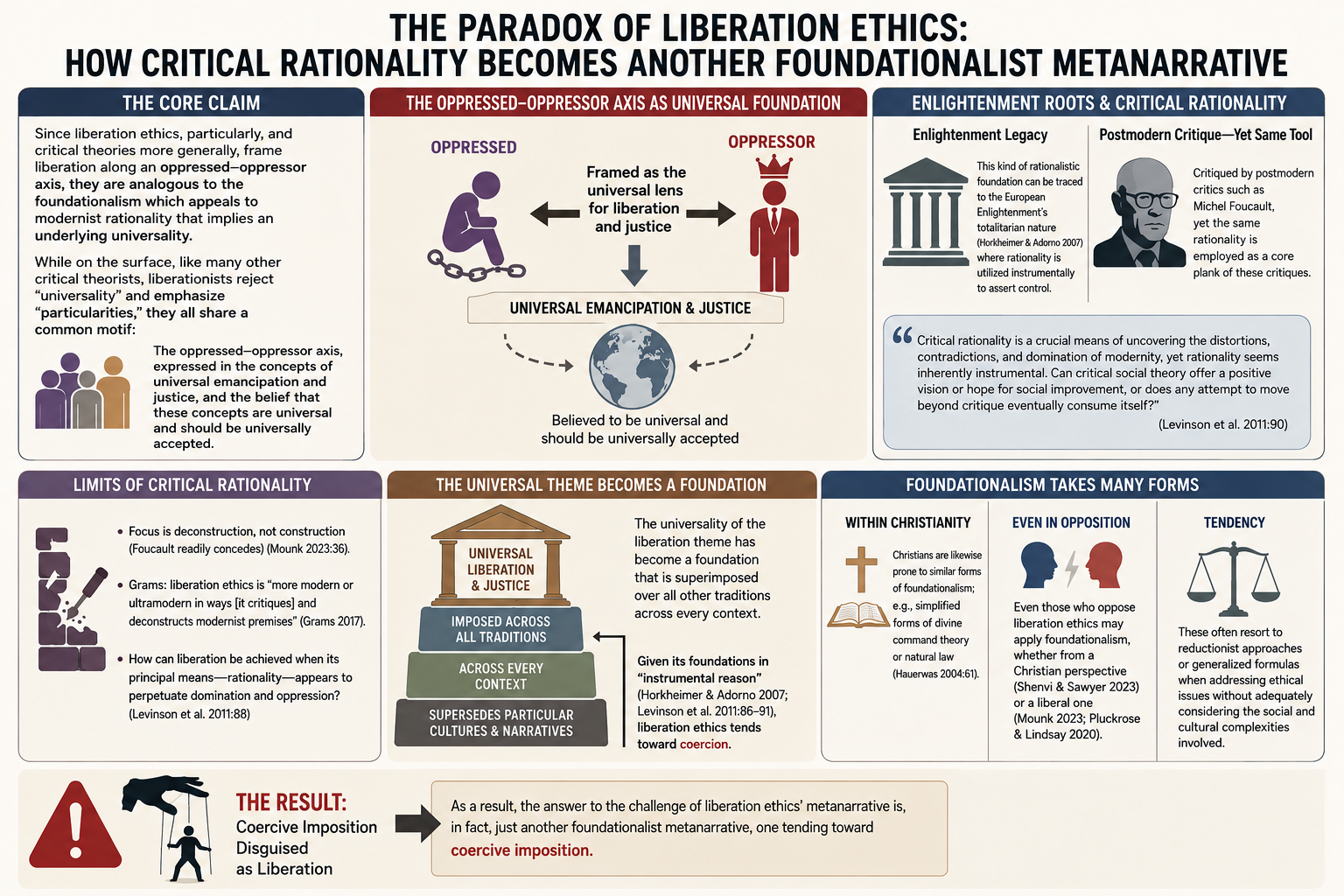
Liberation ethics—the way critical theories are utilized by some theologies/missiologies today frames everything by an oppressor-oppressed binary—itself is coercive and violent. So is fundamentalism. See my reason below, from my article published last month in Mission Studies:
“Since liberation ethics particularly, and critical theories more generally, frame liberation along an oppressed–oppressor axis, they are analogous to the foundationalism which appeals to modernist rationality that implies an underlying universality. While on the surface, like many other critical theorists, liberationists reject “universality” and emphasize “particularities,” it is clear that they all have a common motif: the oppressed–oppressor axis, expressed in the concepts of universal emancipation and justice, and the belief that these concepts are universal and should be universally accepted. This kind of rationalistic foundation can be traced to the European Enlightenment’s totalitarian nature (Horkheimer and Adorno 2007) where rationality is utilized instrumentally to assert control. While this notion of control is critiqued by postmodern critics such as Michel Foucault, the same rationality is employed as a core plank of these critiques: “critical rationality is a crucial means of uncovering the distortions, contradictions, and domination of modernity, yet rationality seems inherently instrumental. Can critical social theory offer a positive vision or hope for social improvement, or does any attempt to move beyond critique eventually consume itself?” (Levinson et al. 2011:90).
This aspect of critical rationality offers little assurance of real positive change insofar as its focus is deconstruction, as Foucault readily concedes (Mounk 2023:36). Grams considers liberation ethics “more modern or ultramodern in ways [it critiques] and deconstructs modernist premises” (Grams 2017). Furthermore, it is also unclear how liberation can be achieved when its principal means, rationality, appears to perpetuate domination and oppression (Levinson et al. 2011:88). In other words, the universality of the liberation theme has become a foundation that is superimposed over all other traditions across every context. Given its foundations in “instrumental reason” (Horkheimer and Adorno 2007; Levinson et al. 2011:86–91), liberation ethics tends toward coercion. Under its premise, social justice often becomes a kind of foundationalist metanarrative (Pluckrose and Lindsay 2020:182–83). Christians are likewise prone to similar forms of foundationalism; for example, those who subscribe to simplified forms of the divine command theory or natural law (Hauerwas 2004:61). Even those who oppose liberation ethics may also apply foundationalism, whether from a Christian perspective (Shenvi and Sawyer 2023) or a liberal one (Mounk 2023; Pluckrose and Lindsay 2020). These often resort to reductionist approaches or generalized formulas when addressing ethical issues without adequately considering the social and cultural complexities involved. As a result, the answer to the challenge of liberation ethics’ metanarrative is, in fact, just another foundationalist metanarrative, one tending toward coercive imposition.”
Article link:
Lin, Khee-Vun. “Missions from the Perspective of Communitarian and Narrative Ethics.” Mission Studies 43, no. 2 (June 5, 2026): 201–20. doi:10.1163/15733831-12342086.
https://brill.com/view/journals/mist/43/2/article-p201_5.xml


Leave a Reply